"Very good. Hans was great! Thanks to him, we also had many spots without many people. He also told us many interesting things about Namibia."
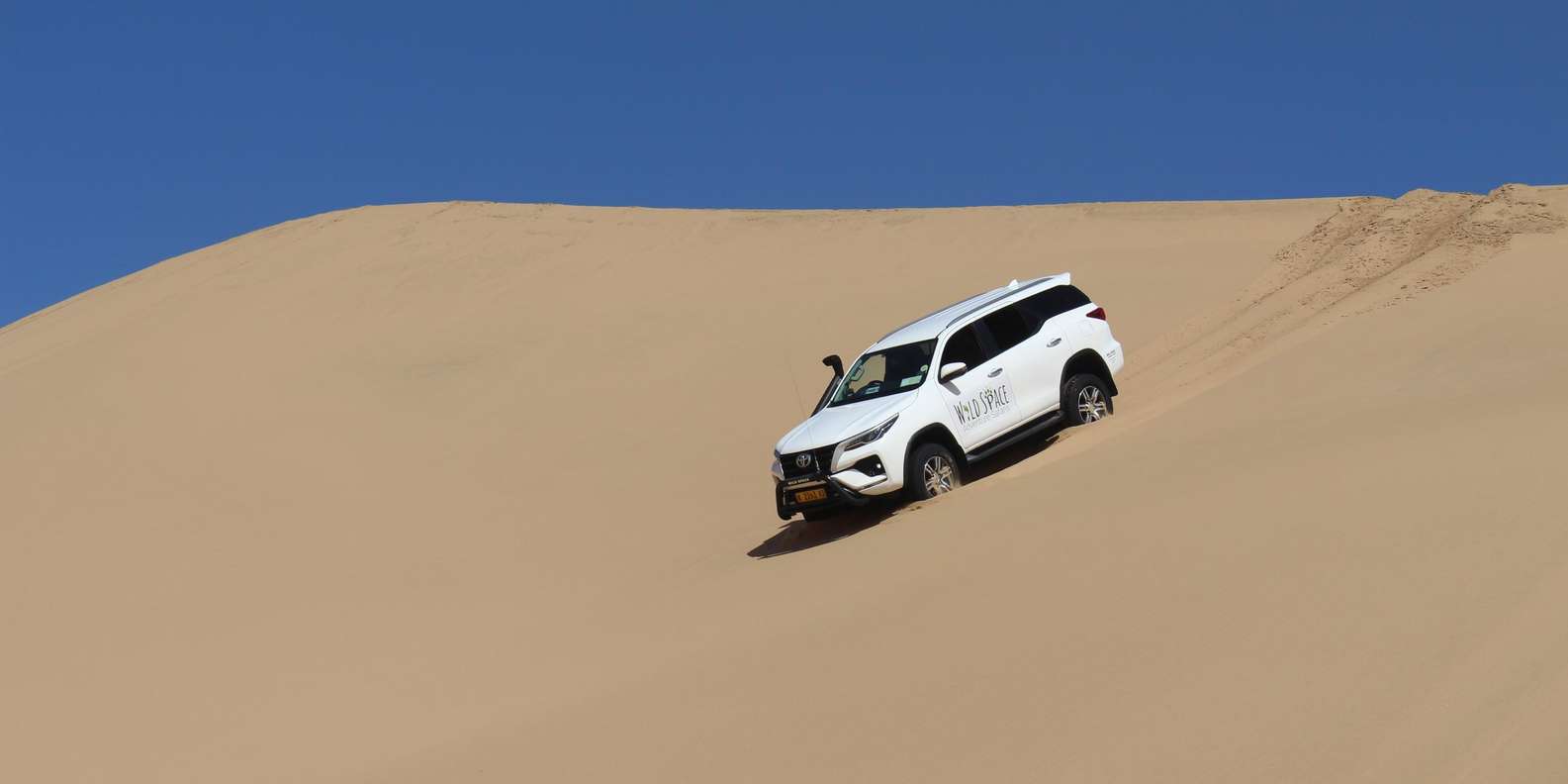
Namib-Naukluft Park · 4x4 Access Only
Sandwich Harbour is where the dunes of the Namib run straight into the Atlantic, and the strip of beach you drive to reach it opens and closes with the tide. Departure times do not move — the route does. This is what that actually means for your day.
The Experience
The park permits are covered here, which is not always so on this shelf; the transfer is not.
Good to know: * Clients arriving with passenger liners / cruise ship will not be picked up at the terminal if Wild Space Adventure Safaris is not informed accordingly. The time slots 08H30 and 13H00 is not applicable to you and an alternative, more realistic time will be provided to you 14 days prior to your arrival. As it takes you up to 3 hours to disembark the passenger liner. · * For excursions to go ahead a minimum of 4 guests are required · * Tours are not private or exclusive and may include other guests who are not a part of your group. · * Due to weather conditions and tides, it is not always possible to reach the Sandwich Bay Lagoon along the beach. In these cases, your tour will drive to the top of the dune overlooking Sandwich Bay. · * Kindly advise if there are any dietary requirements in order to avoid disappointment at picnic time. · * Tour will be conducted in English · Not suitable for: Wheelchair users · Not Included: Transport to and from Swakopmund, Transfers from cruise terminals
Lagoon, salt pans, then the coast — with the tide deciding which way you get there.
Every version of this day opens at the Walvis Bay lagoon, where flamingos and pelicans feed in shallow water a few minutes from town, and then runs on through the salt works and its pink evaporation pans.
The route into the Namib-Naukluft Park is soft sand and beach, which is why these are 4x4 trips rather than minibus tours. Park permits are handled by the operator on most of this shelf.
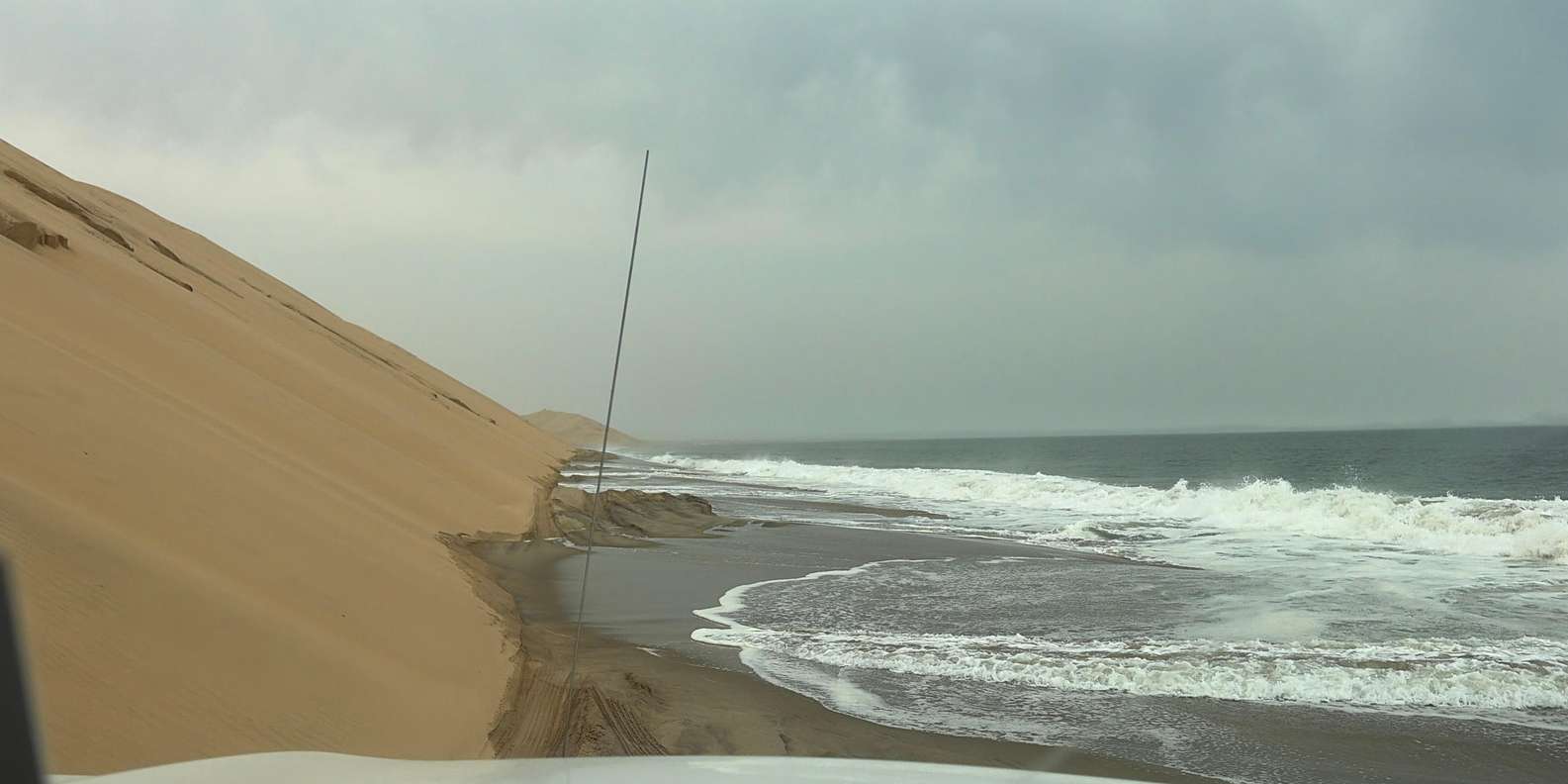
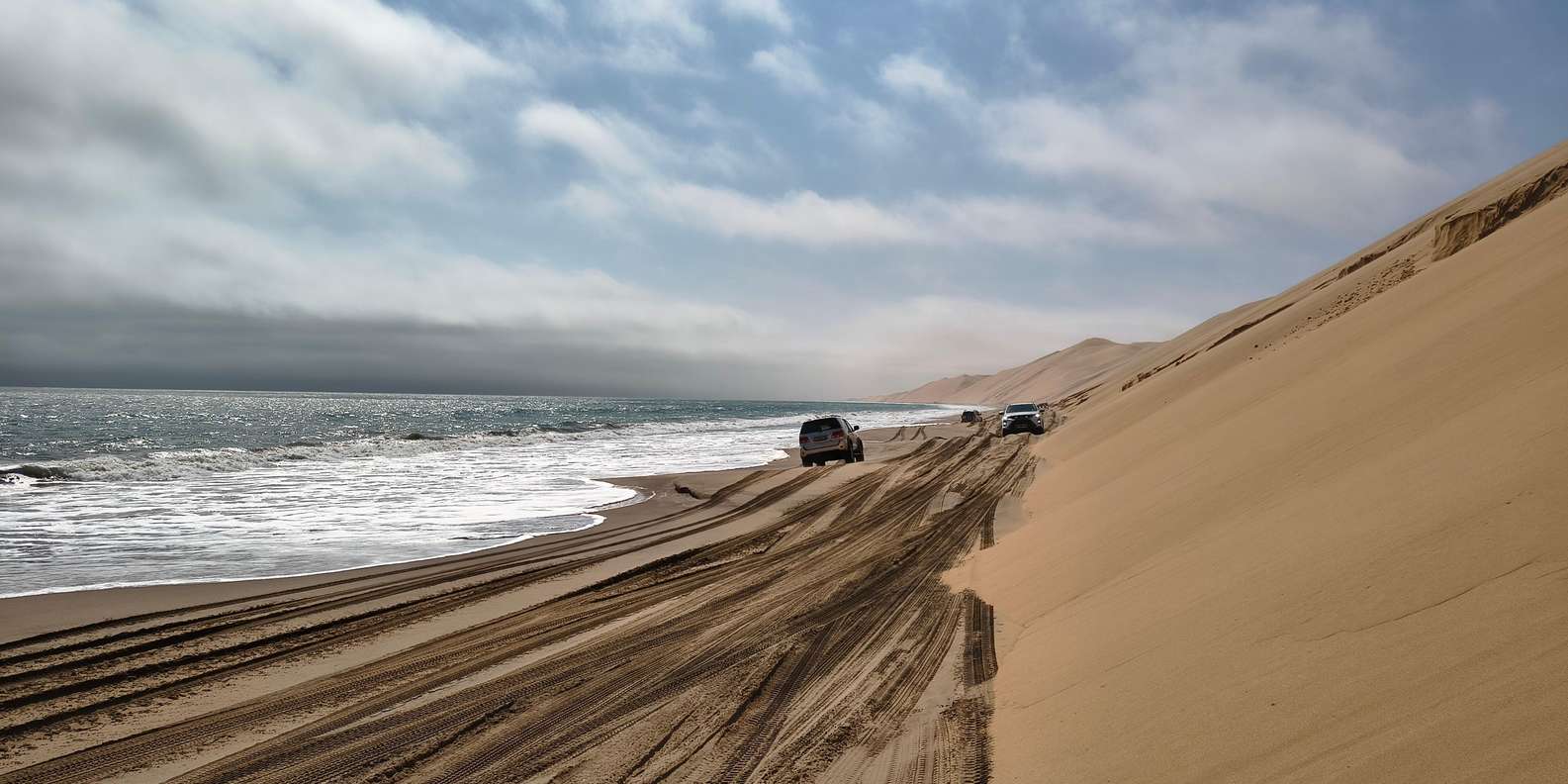
This is the part nobody advertises loudly. If the tide allows, you drive the strip of sand between the dune wall and the surf. If it does not, you climb over the dunes to the lookout points instead, and the last stretch may be on foot. Same destination, different day, and your booking does not decide which.
Lunch is a picnic in the dunes on most trips — a light spread with cold drinks, taken at a viewpoint over the Atlantic. The full-day versions add Pelican Point and its seal colony on the way.
Photo Gallery
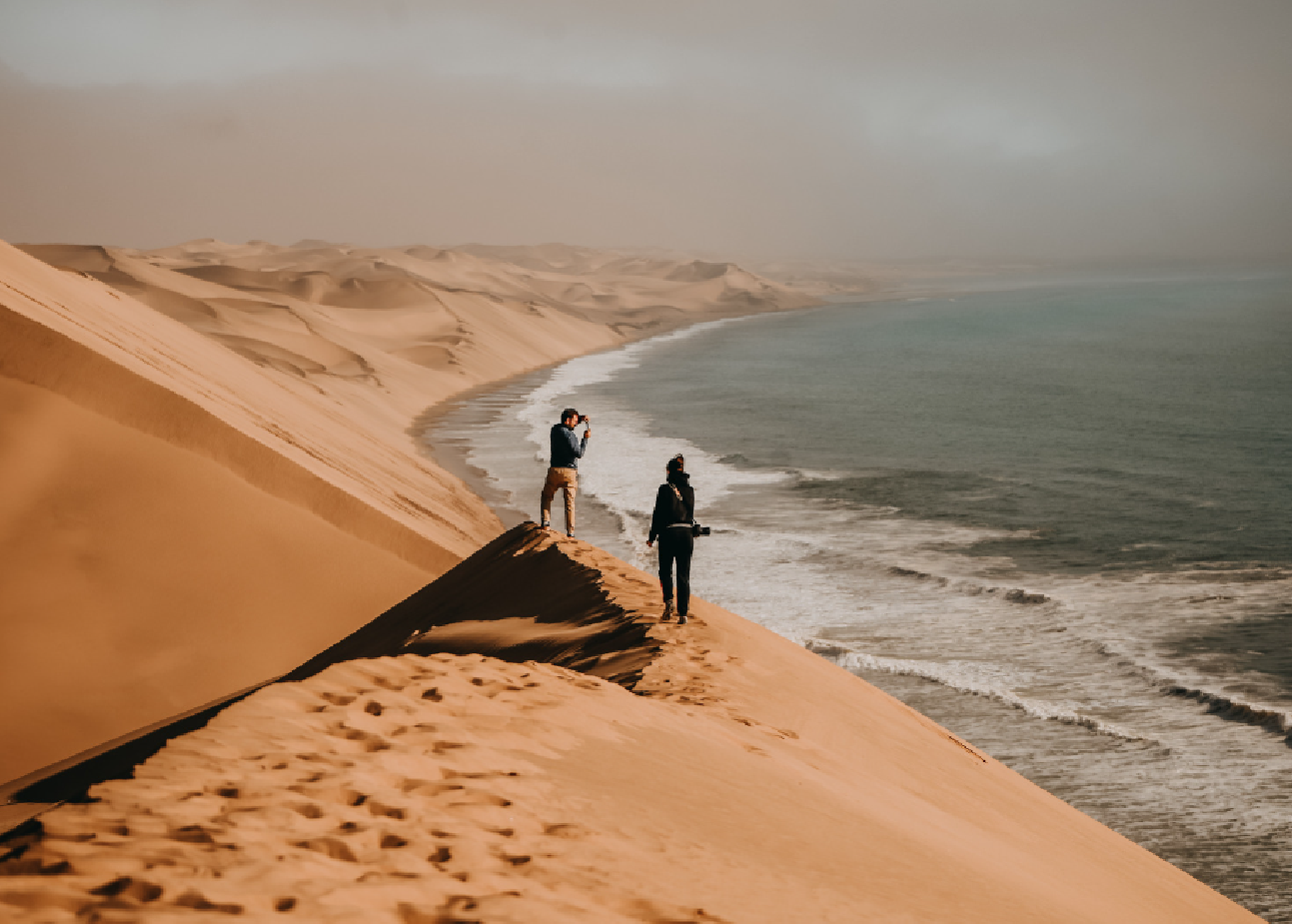
Flamingos on the lagoon, pink salt pans, and the dune wall dropping straight into the surf.


Book Your Experience
Select your preferred date and time. Free cancellation up to 24 hours before departure.
All five drive the same coastline. What separates them is how long you are out, whether the seals are included, and — the one people miss — whether the transfer from Swakopmund is.
| Feature | WHAT WE'D BOOK Half-Day from Walvis Bay | With Swakopmund Pickup | Full Day + Pelican Point |
|---|---|---|---|
| Starting Price | From $128/per person in current promotion (usually $151) | A step up, and it buys the transfer | The most expensive of the three, for roughly double the time |
| How Long You're Out | Half a day — about four hours on the ground | Half a day, plus the run down from Swakopmund and back | A full day |
| Getting There From Swakopmund | NOT included — the listing excludes transport to and from Swakopmund | Included, free, from your accommodation | Included — Walvis Bay, Langstrand or Swakopmund |
| Park Permits | Included | Included | Included |
| Pelican Point Seals | No | No | Yes — around an hour and a half at the peninsula |
| Food | Light picnic lunch with cold drinks | Light lunch with sparkling wine and refreshments | Light lunch with sparkling wine and refreshments |
| How Much Feedback Behind It | By a wide margin the deepest review base on this shelf | A solid, strongly rated sample | A small sample, strongly rated |
| Who It's For | Anyone staying in Walvis Bay, or with their own transport down from the coast | Anyone staying in Swakopmund — which is most visitors | People who want the seals as well, and have a whole day to give it |
| Check Availability | See the Swakopmund Pickup | See the Full Day |
The Alternatives
Half-day, full-day with Pelican Point, or a catamaran-and-braai version. Read the pickup line before the price line — the cheapest headline does not collect you in Swakopmund.
 SWAKOPMUND PICKUP
You will first be collected by your guide for the day, then head out on the adventure of a lifetime. Your adventure starts off in Walvis Bay lagoon witnessing …
 ADDS PELICAN POINT
"a beautiful mix of nature's landscapes and creatures" This full day adventure starts off at the Walvis Bay lagoon witnessing thousand of Greater and Lesser …
 EVERYTHING INCLUDED
Begin your adventure at the Walvis Bay Lagoon, home to flamingos, pelicans, and other birdlife. Continue across the Kuiseb River delta and salt pans before heading …
 CATAMARAN + BRAAI
Explore Sandwich Harbour and its ancient dunes with a 4x4 adventure and a stop on the deserted beach of Pelican Point for a delicious lunch. Start or end your day …
Before You Book
The tide decides whether you drive the beach or go over the dunes. Where you are sleeping decides whether the cheapest listing on the shelf actually collects you. Everything else is broadly the same trip.
Sandwich Harbour is a lagoon roughly 55 kilometres south of Walvis Bay where the dune field of the Namib runs out of land and drops straight into the Atlantic. It sits inside the Namib-Naukluft Park, at the northern edge of the Namib Sand Sea, inscribed by UNESCO in 2013 — and it is a Ramsar wetland of international importance in its own right, listed in August 1995.
You cannot drive there casually. You need a permit, you need a 4x4, and — the part that shapes the actual day — you need the right tide.
This is worth being precise about, because a lot of pages get it backwards.
Departure times are fixed. The main operator publishes a morning and an afternoon slot and runs them regardless. What the tide changes is what happens once you are down the coast.
If it is out, you drive the strip of sand between the dune wall and the surf — the photograph everyone comes for. If it is in, that strip is under water, and you go over the dunes to a lookout instead, sometimes finishing the last part on foot.
The mechanism is not depth. The spring tidal range here averages about 1.4 metres, which is modest. It closes the route because of geometry: with a near-vertical dune face meeting the ocean, the driveable corridor is only metres wide, so a small rise swallows all of it.
No operator publishes a tide threshold, and none can promise you the beach. The honest version is that both days are good and only one of them is the postcard.
The cheapest listing on this shelf — and the best-reviewed, by a wide margin — is a half-day out of Walvis Bay, 606 reviews at 4.9/5 from $128 in current promotion (usually $151). It is the one we would book, and its own listing excludes transport to and from Swakopmund.
That matters because most visitors to this coast sleep in Swakopmund, 35 km up the B2, not in Walvis Bay. If that is you, either arrange your own run down, or pick one of the trips that collects you: two on this shelf include Swakopmund pickup at no extra charge, and one of those adds Pelican Point as well.
It is a small thing that turns a cheap tour into an expensive morning.
Birds, and a great deal of nothing.
The Walvis Bay lagoon you pass on the way out is separately Ramsar-listed and genuinely spectacular: a winter 2026 count recorded just over 87,000 birds, including 51,000 flamingos. Numbers roughly double in summer as the inland pans dry and the birds come back to the coast, but the lagoon is never empty — that figure is the low season.
At Sandwich Harbour itself there is no settlement, no kiosk and no ruin worth the name. The bay was a small whaling and fishing port in the nineteenth century; the sand spit sheltering the anchorage broke away around 1890 and the harbour died. A 1930s scheme to pump an artificial guano island into the lagoon failed for the most Namibian reason imaginable — jackals walked out to it at low tide and cleared the birds off. Effectively all that survives is a manager’s house, and the sand is taking that too.
Come for the landscape. There is nothing to visit.
Pelican Point records the highest average fog frequency ever measured in the Namib: 146.5 days a year, across a 27-year run of observations, with individual years ranging from 105 to 200. Forty kilometres inland that falls to about 40 days. This is the fog desert, and it is the reason anything lives here.
So a foggy start is normal rather than a ruined morning — it typically clears through the late morning, which is a soft argument for the afternoon departure if what you want is crisp dune photographs. April to September is the foggiest stretch. Rainfall is under 20 mm a year, so wet weather is not something to plan around.
Anyone pregnant, and anyone with back or neck problems. The operators say so themselves — this is sustained driving over soft dunes and it is genuinely rough. If you are prone to motion sickness, treat it accordingly.
Minimum ages differ by operator, so check rather than assume. Drones are not permitted.
Everyone else: the comparison is here, and the honest question of whether you could just drive yourself has a more complicated answer in 2026 than it did two years ago.
Guest Reviews
"Very good. Hans was great! Thanks to him, we also had many spots without many people. He also told us many interesting things about Namibia."
"Fantastic landscapes, an organized tour with the right timing, and a super knowledgeable and courteous guide. An experience I would absolutely do again!"
"The experience was incredible!!! Our tour guards Mr. Hans and Mr. Mike (in Tom & Jerry rides 😀) were amazing!!! We had an experience of a life time!!! Thank you for the great memories created!!! Highly recommendable!!!"

"our guide was very knowledgeable and provided a lot of information. the route was very fun and a thrill to be in the car, especially on the dunes. the views were just what we wanted. the food was also very good. definitely recommend the experience!"
"Great experience on the dunes and lots of good explanations. Hans puts his heart and soul into it!"
"Perfect organization, excellent aperitif in the desert, and the driver was very helpful with photo stops and explanations"
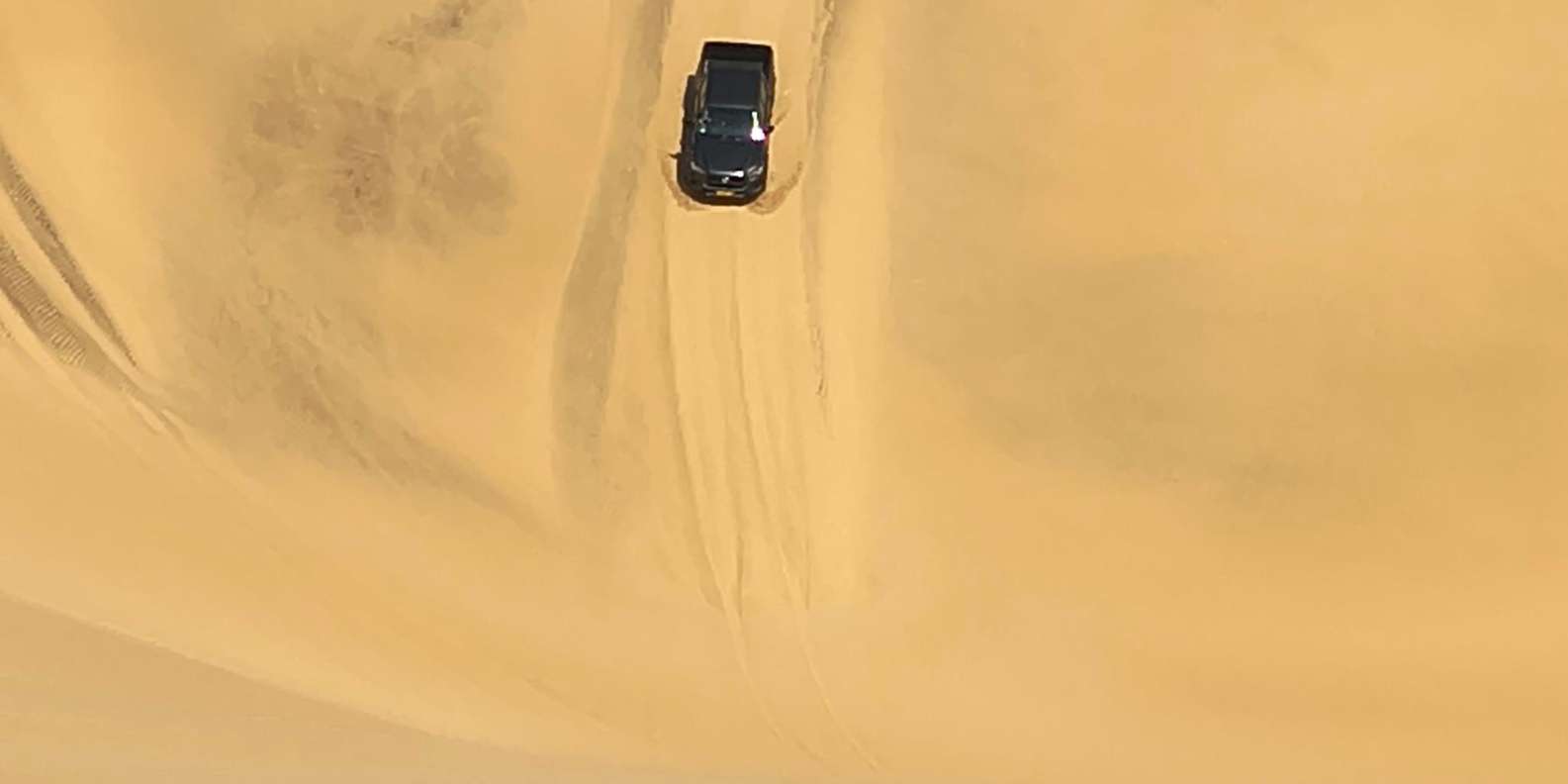
"Great excursion to the dunes; Mike was a very good guide"
"A beautiful experience in the middle of the Sandwich Harbour dunes. During the trip, our guide also gave us a lot of information about the local context. The tour includes several stops in the middle of the dunes for walks and photos. We took the morning tour and also walked along the shoreline below the dunes (which, according to our guide, is not always possible in the afternoon due to high tide). We really appreciated the light lunch."
Read all 606 verified reviews
See All ReviewsThe most-reviewed Sandwich Harbour trip is a half-day 4x4 excursion out of Walvis Bay — 4.9/5 from 560 verified guests, from about $128, with park permits and a picnic lunch included. Transfers from Swakopmund are not included in this one; check the alternatives if that is where you are staying. Free cancellation. Starting from $128 per person in current promotion (usually $151).
Check Availability & BookCan't Make These Dates?
Find a tour that fits your schedule. Dates and cancellation terms are on each listing.
Including the two the operator listings answer differently from each other.
Yes, if what you want is landscape. It is one of very few places on earth where a live dune field meets an ocean with nothing in between — no road, no town, no viewing platform. It is not worth it if you are expecting a destination: there is no settlement, no café and no ruin to speak of. You go, you look at something enormous, you come back. Set that expectation and it delivers completely.
For the meeting of the two things. The Namib runs out of desert exactly here and drops into the Atlantic, and the lagoon behind the dunes is a Ramsar wetland of international importance, listed in 1995. It also sits at the northern edge of the Namib Sand Sea, which UNESCO inscribed in 2013. The fame is geographic, not historic.
Roughly 55 km south — that is the Ministry's own figure. Be warned that published distances vary a lot: you will see 50, 55, 64 and 80 km quoted by different sources, most likely because some are measuring the direct distance and others the driven route out via the salt works and down the beach. Nobody publishes a straight drive time either; what is published is that the half-day trip runs about four hours door to door.
Probably after a ship. In the late 1780s the London whaling firm Samuel Enderby & Son worked this coast, and the name "Sandwich Harbour" first appears in print on a chart of 1791 — naming a bay after your vessel was ordinary practice. The rival theory is that it corrupts a German or Afrikaans word for a sand-shark, which is why old maps show Sandvisbaai and Sandfisch Bai. The origin is not settled, but only the ship account rests on a dated document, so "probably" is the right word. One correction: the vessel was a commercial whaler, not "HMS" anything.
No — effectively nothing remains. It was a modest whaling and fishing port in the nineteenth century, and the sand spit sheltering the anchorage broke away around 1890, leaving the bay too shallow for ships. A 1930s attempt to pump an artificial guano island into the lagoon failed when jackals walked out to it at low tide and drove the birds off. All that is left is a manager's house, and the sand is taking that too. The archaeological record beneath the site goes back around a thousand years; almost none of it is visible.
It decides your route, not your departure time. Times are fixed. What the tide changes is whether you drive the strip of sand between the dune wall and the surf, or go over the dunes to a lookout instead — sometimes walking the last part. The spring range here is only about 1.4 metres, but with a near-vertical dune face meeting the sea, the driveable corridor is metres wide, so that is enough to close it. No operator publishes a tide threshold and none can promise you the beach. The full explanation is here.
Not simply. A permit has always been required and is issued by the Ministry — the practical office is in Swakopmund. Since a 25-year concession awarded in July 2024, self-drivers not accompanied by a registered operator are routed through a concessionaire at the gate; tour operators disputed the arrangement publicly and in court. Self-driving is not banned, but it is no longer permit-and-go, and we cannot tell you what the gate is actually enforcing today. Check before committing.
Some do, and this is the detail that catches people out. Most visitors to this coast sleep in Swakopmund, about 35 km up the B2, not in Walvis Bay — but the cheapest and best-reviewed trip on this shelf explicitly excludes transport to and from Swakopmund. Two others include Swakopmund pickup at no extra charge. Read the pickup line before the price line.
A count at the end of August 2026 recorded just over 87,000 birds, including 51,000 flamingos — and that is the winter figure. Numbers roughly double in summer, when the inland pans dry out and the birds return to the coast. So the lagoon is never empty; people who say there is an off-season with barely any flamingos are not describing what the counts show. It is free to visit, on the edge of town.
Nobody actually knows, and we would rather say so. You will see 50,000, 55,000 and 100,000 quoted — the 100,000 figure belongs to Cape Cross, a different and much larger colony 130 km north, and the others have no published basis we could find. The best-documented figure is scientific: more than 12,000 pups were born at Pelican Point by 2011, at a colony that was growing over 20% a year. It is a big, loud, recently established colony. That much is certain.
Statistically, as bad as it gets anywhere in the Namib — and that is the point of the place. Pelican Point records the highest average fog frequency ever measured in the desert: 146.5 days a year, over a 27-year run, ranging from 105 to 200 days. Forty kilometres inland it falls to about 40. This is a fog desert; the moisture that keeps everything alive arrives that way rather than as rain. It typically clears through the late morning, which is a mild argument for the afternoon slot if you want crisp dune photographs.
There is no bad month, and the usual Namibia seasonality advice does less work on this coast. Rainfall is under 20 mm a year, so there is no wet season to dodge. Winter brings more fog days but also the hot dry berg winds that give the crispest visibility and mild temperatures; summer is warmer and hazier. The variable that actually shapes your day is the tide, not the calendar.
The operators are direct about it: not suitable if you are pregnant, or have back or neck problems — it is sustained driving over soft dunes and it is genuinely rough. Take precautions if you are prone to motion sickness. Minimum ages differ between operators, with some accepting small children and others excluding under-threes, so confirm rather than assume. Drones are not permitted.
A warm layer — the coastal morning is cold and foggy far more often than visitors expect, whatever the interior is doing. Flat shoes, because you may walk the last stretch over a dune. Sunglasses and sunscreen for after it clears. Lunch and drinks are included on every trip on this shelf, so you do not need to carry food.
Still have questions? Email us at info@walvisbaysandwichharbour.com